
Montgomery County Release Meanings
A release is an event, not one broad status. At Montgomery County Detention Center, a person may leave after bond, dismissal, acquittal, time served, sentence completion, or another court-authorized discharge. Yet the jail may also relinquish custody through a transfer. Transfer to Southern Correctional Institution, another county jail, a federal custodian, or immigration authorities does not mean the person returned to the community. The first useful question is when Montgomery County custody ended. The second is where the person went.
Montgomery County release records must be read in that context. A bond release ends physical confinement while the case stays open. Time served ends the custodial part of that judgment, although probation or another case may continue. A dismissal is a court result, but the jail record supplies the actual processing time. Parole applies mainly to eligible older-law sentences. Post-release supervision, often shortened to PRS, is the supervised period after many current felony prison terms. A discharge can mean the end of an incarceration or correctional service period, depending on the record.
| Release event | What it means | Best next source |
|---|---|---|
| Bond or court order | Local physical custody ended while a case may remain open | Sheriff release record and court file |
| Time served or sentence end | The stated custodial term ended | Jail record, judgment, and any supervision record |
| Transfer | One agency handed custody to another | Named receiving agency |
| Prison release or parole | NCDAC incarceration ended, possibly with supervision | OPI and Community Supervision |
| Dismissal or acquittal | The court resolved the charge without conviction | Clerk record plus jail exit record |
Montgomery County Release Record Fields
The Montgomery County Sheriff does not publish an online release archive or a fixed field schema. A written request should therefore identify one person and one booking episode, then name the public fields sought. Some requested facts may appear on separate booking, movement, or release sheets. Confidential medical, juvenile, security, investigative, sealed, and expunged material can be withheld or redacted. The list below is a request inventory, not a promise that every item exists in one form.
| Field | What it can establish |
|---|---|
| Full name and aliases | The identity linked to the booking |
| Booking number and date | The exact Montgomery County custody episode |
| Arresting agency and charges | Who initiated the booking and the cited allegations |
| Bond and court file | The related release authority or pending case |
| Release date and time | When Montgomery County physical custody ended |
| Release disposition | Bond, time served, transfer, or another recorded reason |
| Destination notation | A receiving agency, where public and recorded |
| Booking photograph | The image tied to that booking, if disclosable |
What if the person is simply “not here”? That response does not prove release home. Ask whether staff can disclose a release or transfer date, the recorded disposition, and the destination agency. The same name may also be tied to more than one booking.
Request Montgomery County Release Records
For an immediate custody question, call Montgomery County Detention Center at 910-576-4261. A historical or documented release request goes to the Montgomery County Sheriff’s Office, 111 W. Main Street, Troy, NC 27371. The administrative line is 910-572-1313, fax is 910-572-9236, and listed office hours are Monday through Friday, 8:00 a.m. to 5:00 p.m. No Sheriff-specific online request form, set booking-photo fee, or promised response time was found.
- Give the full name, known aliases, approximate booking range, and a booking or case number when available.
- Ask for existing booking and release records, including date, time, disposition, releasing authority, and any public transfer notation.
- Request the booking photograph separately and allow the custodian to apply any lawful exemption or redaction.
- Ask for electronic copies if the records already exist in that form and request an advance cost estimate.
- For any withheld part, ask the office to identify the legal basis. Narrow the range if an extensive-service charge may apply.
North Carolina General Statutes Chapter 132 provides inspection and copy rights subject to exceptions. G.S. 132-6.2 generally limits an uncertified copy fee to actual reproduction cost, though a reasonable special-service charge may apply to work requiring extensive staff or technology resources. The law does not require staff to create a new report or answer an analysis that no existing record contains.
Note: Ask the custodian how far back the requested jail data remains available because no local public retention window is posted.
Montgomery Release Record Access Law
North Carolina public-record law starts broadly but contains specific limits. G.S. 132-1 covers material made or received in public business, including photographs and electronic records. G.S. 132-6 addresses inspection and copies, while G.S. 132-6.2 covers the available medium and copy charges. Those provisions support a focused request for an existing Montgomery County booking and release record. They do not turn every jail file into an open record or override a more specific confidentiality rule.
G.S. 153A-98(c)(8) addresses certain public facts about confinement in a county facility. Criminal investigative and intelligence records receive different treatment under G.S. 132-1.4. Public arrest facts can be available while an investigative narrative, security detail, medical record, victim detail, or confidential source material remains closed. Juvenile, sealed, and expunged records also require their own legal analysis.
A booking photograph needs a specific request. G.S. 15A-502 authorizes photographs in stated booking and commitment settings, but it does not require the Sheriff to post an online gallery. The records custodian should decide whether the requested image is a booking photograph, an investigative photograph, or another protected item. If access is denied or limited, ask for the cited legal basis and any separable public portion. This keeps the request tied to actual Montgomery County records rather than assumptions about another sheriff’s website. It also avoids treating a press image, state prison image, or old private copy as the county booking photograph.
Montgomery Release Records After Expunction
An expunction is a court-ordered process that removes, destroys, or segregates covered state records under the controlling statute. Eligibility depends on the charge, disposition, offense, age, history, and waiting period. A petition is filed in the county of charge or conviction. For a Montgomery County matter, the Clerk of Superior Court is the local procedural anchor. An expunction should never be treated as permission to reconstruct sealed history from an old copy.
The North Carolina Judicial Branch expunction guidance notes that processing may take months and that a general filing fee applies with statutory exceptions. Private copies do not automatically disappear when official relief is granted. If court-system information remains after an order, contact the clerk that granted it. Keep the original granted order safe because a replacement may not be available after covered files and the order are destroyed. This local filing and record-preservation issue is separate from asking the Sheriff for an ordinary Montgomery County release record.
Find Montgomery County Released Inmates
There is no single Montgomery County database that covers every custody type. Start with the last known agency and follow the handoff. The county publishes no live roster or recent-release archive, so an empty web result cannot serve as proof. A person booked only for a local pretrial matter may never enter the state correctional database. In contrast, someone transferred from the county jail to state prison should move into NCDAC records after admission processing.
- Call the detention center and ask if the person is now held. If not, request the public date and disposition by which county custody ended.
- Use NC SAVAN or VINELink for a named custody record and notification, then confirm the displayed agency.
- Use NCDAC Offender Public Information when state prison or Community Supervision is relevant.
- Check the North Carolina court case for bond, dismissal, judgment, sentence, probation, or later orders.
- Use BOP or ICE only when the facts point to federal or immigration custody.
- Request the existing release record when the online paths are missing, stale, or unclear.
Montgomery State Release Search
NCDAC Offender Public Information, or OPI, covers North Carolina adult correction records. Search by offender number first when known because it follows a person across commitments and aliases. Otherwise, use last and first name, then narrow same-name results with available age, gender, or race fields. Open the matching profile and read both the incarceration header and the probation, parole, or post-release status. “Inactive” must be reconciled with the detail history rather than translated into a broad claim.
The official OPI form is shown below before a name is entered.
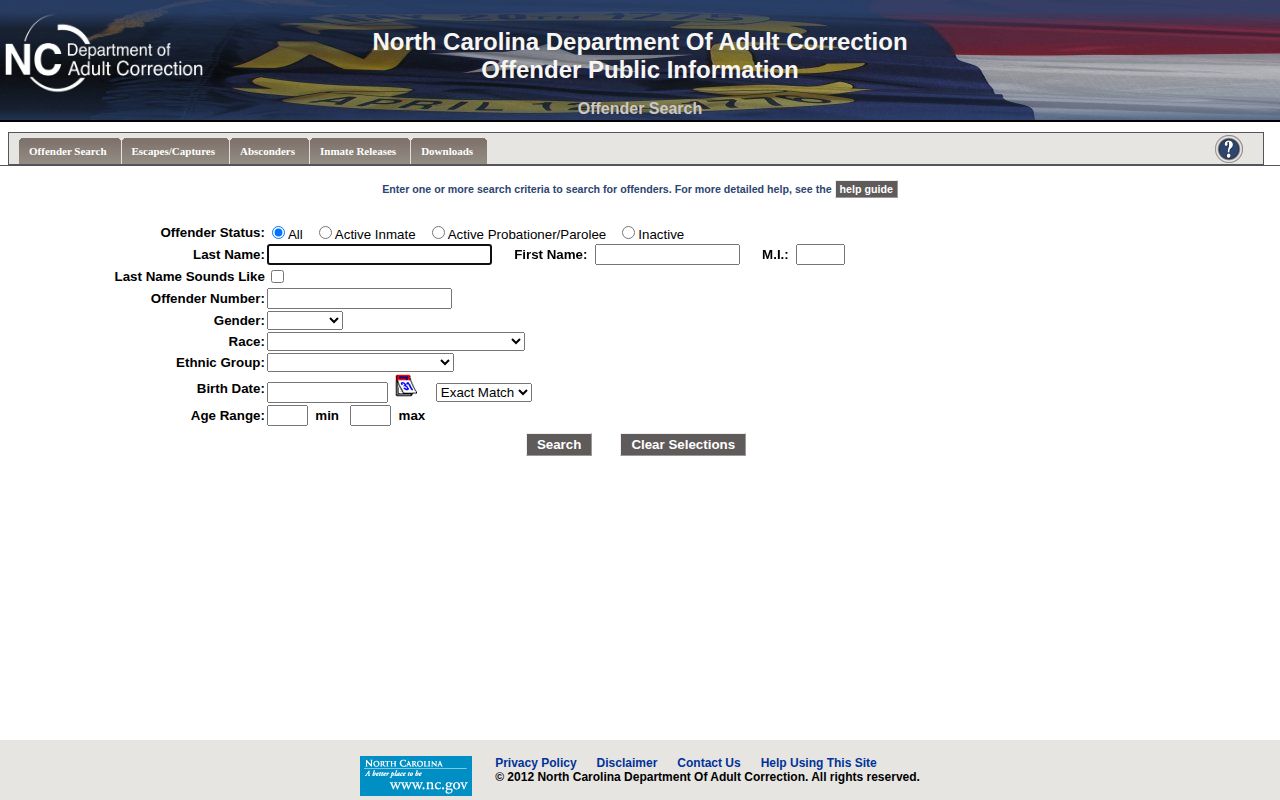
The form supports a state-prison and supervision search, not a Montgomery County jail-only booking. Read offense and sentence blocks, admission and release-related dates, current location when active, aliases, and the most recent supervision period. An actual prison release can be followed by active PRS, parole, or probation.
- Discharge
- The recorded end of an incarceration, supervision, or correctional service period, as labeled by the source.
- Parole
- Discretionary early release used mainly for eligible older North Carolina sentences.
- Probation
- Court-ordered community supervision, often imposed instead of some or all active jail time.
- Post-release supervision
- A supervised term that follows many current-law felony prison releases.
Montgomery Monthly Prison Releases
NCDAC also provides a separate Inmate Release Search. It can filter by Release County, year, and month, with Montgomery listed as county option 62. Results observed during research included offender number, name, release date, primary offense and qualifier, and type of release. The visible years can roll, so use the choices displayed on the live form.
The state monthly tool is unusually useful for Montgomery County released inmates, but its boundary matters. It covers NCDAC state-prison releases associated with a release county. It is not a Sheriff 24-hour or 72-hour list, and it does not show every person who left Montgomery County Detention Center. A user may manually inspect dates within a month, but the source window and population remain state based.
The Montgomery-filtered NCDAC release form illustrates that separate search.
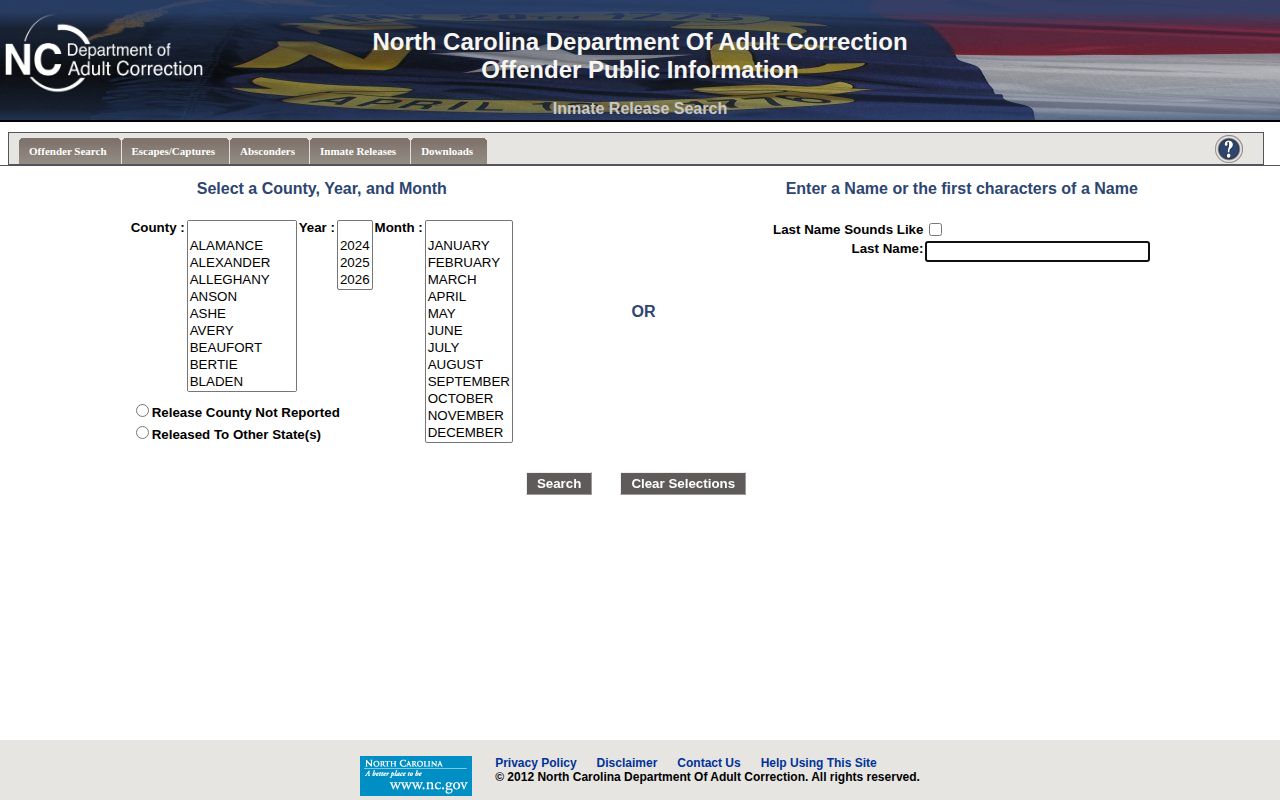
Use the offender number from a result to open the full OPI history. That second check helps distinguish expiration, parole, a later supervision period, or another service status.
Montgomery Court Release Reasons
The Montgomery County court file explains why custody may have ended. North Carolina eCourts Portal searches can expose case summaries, actions, judgments, hearings, and dispositions within the user’s access level. Search by case number when possible. A party-name search needs care because names are not unique. Look for bond orders, dismissal, plea, verdict, judgment, sentence, probation, and later compliance or revocation events.
The North Carolina eCourts public portal provides the statewide electronic starting point.
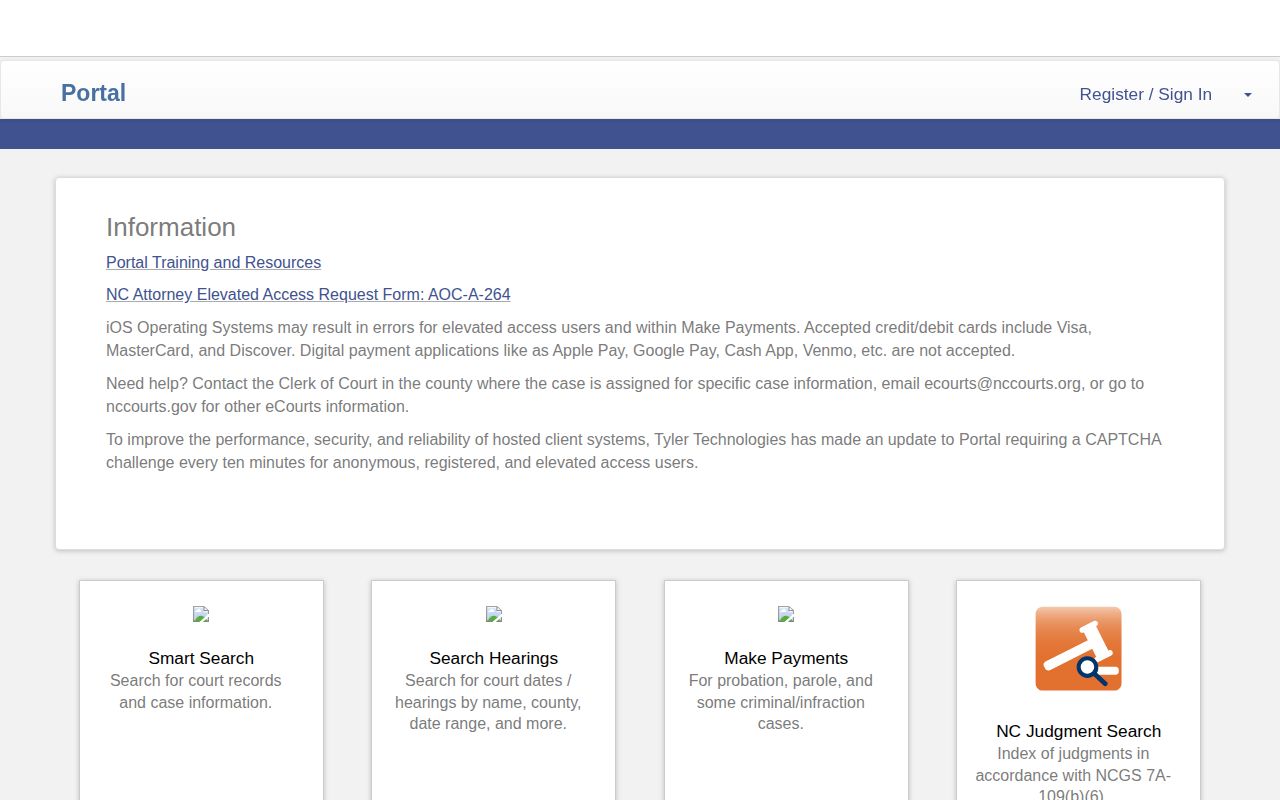
A docket event can explain legal authority, but it does not prove the minute jail staff completed release or whether an outside hold intervened. The official file comes from the Montgomery County Clerk of Superior Court at 108 E. Main Street, Troy, with the main line 910-571-3700 and weekday hours from 8:00 a.m. to 5:00 p.m. Ask for the judgment, commitment, release-related order, or certified disposition, then pair it with the jail release sheet.
Montgomery Release Reentry Contacts
An official NCDPS Montgomery resource sheet lists Community Corrections in Troy, NC TASC, the Division of Motor Vehicles, Department of Social Services, and other local contacts. That list can help a released person identify public offices relevant to the next step. It does not mean each service is available to every person, and it does not prove current supervision or release status.
The Montgomery resources sheet is dated. Verify each listing before travel or before relying on its hours and phone details. Current supervision status should come from OPI and the current Community Supervision office roster. Service navigation and custody verification answer different questions.
Two Glen Road Release Systems
Montgomery County has a rare source of confusion. Montgomery County Detention Center is at 206 Glen Road, while Southern Correctional Institution is at 272 Glen Road in Troy. The buildings are close, but the agencies and records are separate. The Sheriff operates the adult county jail. NCDAC operates Southern as a male close-custody state prison.
A move from the detention center to Southern is a transfer into state custody, not release to the community. The county record should identify the handoff, while OPI becomes the next person-level source after state admission. Southern opened in 1983, and the former Montgomery Correctional Center merged into it in 1996. The institution returned to a male close-custody mission in 2019. History can clarify an old facility name, but only a person-level record confirms an individual’s status.
Montgomery Release Search Boundaries
Each system answers a narrow question. NC SAVAN and VINELink provide named-person custody information and event alerts for participating reporting agencies. They do not certify a release sheet or reconstruct everyone released in a date range. BOP can show current and former federal prisoners within its coverage. ICE’s locator focuses on present detention and a limited recent-release window. Neither source proves the end of all other custody.
| Situation | Use first | Do not infer |
|---|---|---|
| Local booking | Detention center and Sheriff record | No web result does not prove release |
| State commitment | NCDAC OPI | Leaving the jail does not end state custody |
| Named custody alert | NC SAVAN or VINELink | An alert is not a certified release document |
| Federal sentence | BOP locator | Released from BOP does not exclude another hold |
| Immigration handoff | ICE locator and responsible office | Leaving county custody may be a transfer |
Juvenile matters follow a separate confidential route. A parent, guardian, attorney, or other authorized person should contact Juvenile Justice or the juvenile court channel. Adult OPI and general adult custody tools are not a public shortcut to youth release information.
Montgomery County Release Facilities
Three facility paths are relevant, but only two facilities sit in Montgomery County. The county jail handles local adult custody. Southern handles adult state-prison confinement. Richmond-Jenkins is a regional juvenile detention center outside Montgomery County and uses confidential, authorized-person routing.
- Montgomery County Detention Center: confirm local release or transfer with the jail, Sheriff record, court case, and SAVAN.
- Southern Correctional Institution: verify prison release, transfer, discharge, and later supervision through NCDAC.
- Richmond-Jenkins Juvenile Detention Center: authorized Juvenile Justice or juvenile court contact only.
The Statewide Misdemeanant Confinement Program adds another local wrinkle. A person serving a misdemeanor at the Montgomery jail may have been convicted in another participating county, and a Montgomery defendant may be housed elsewhere. Use the actual releasing facility and court of conviction rather than assume they are the same place.