
Montgomery Projected and Actual Dates
NCDAC Offender Public Information uses the exact label Projected Release Date. That field is a sentence calculation for an active state correctional term. Sentence-history blocks can also show Actual Release Date, which records the end of an incarceration period. The two fields should never be swapped. A projected date can change; an actual date records a past event in that period.
Strong confirmation reads more than one field. Compare Actual Release Date and service status, such as EXPIRED, with the header’s inmate and supervision statuses. A person may be out of prison but active on post-release supervision, parole, or probation. A transfer between prisons changes the location but is not community release. A county jail handoff to NCDAC is also a transfer.
A pretrial detainee at Montgomery County Detention Center has no sentenced-prison projected date. Bond, a judge’s order, case disposition, and any outside hold control release. Even after a judge authorizes release, jail staff must complete processing and check other custody demands. The court record explains authority; the jail record supplies the physical release time.
Find Montgomery Projected Release Dates
Begin with the custody system that owns the sentence. Southern Correctional Institution is an NCDAC state prison, while Montgomery County Detention Center is a sheriff-operated county jail. Though both are on Glen Road in Troy, their release records and date calculations remain separate.
- For a state prisoner, open NCDAC Offender Public Information. Search by offender number when possible, or use the name and allowed filters to distinguish matches.
- Open the matching record and read the active or inactive header, sentence blocks, Projected Release Date, and any Actual Release Date. Preserve the offender number.
- For a county detainee, call Montgomery County Detention Center at 910-576-4261. Ask whether the person is pretrial or sentenced and whether a public release or transfer date can be given.
- Use the court case for the judgment, commitment, bond order, sentence, and credit ordered by the judge. Ask the jail for its own computation when a county sentence is being served.
- When the public NCDAC view is incomplete, submit an NCDAC public-records request with the offender number and commitment period.
OPI covers state adult corrections and Community Supervision, not a short county-only stay that never became an NCDAC case. The Montgomery County released-inmate search sets out the other agency paths when the starting custody is unclear.
The official search form shows the fields used to start a state record lookup. Open NCDAC Offender Public Information to compare the live form with the captured view.
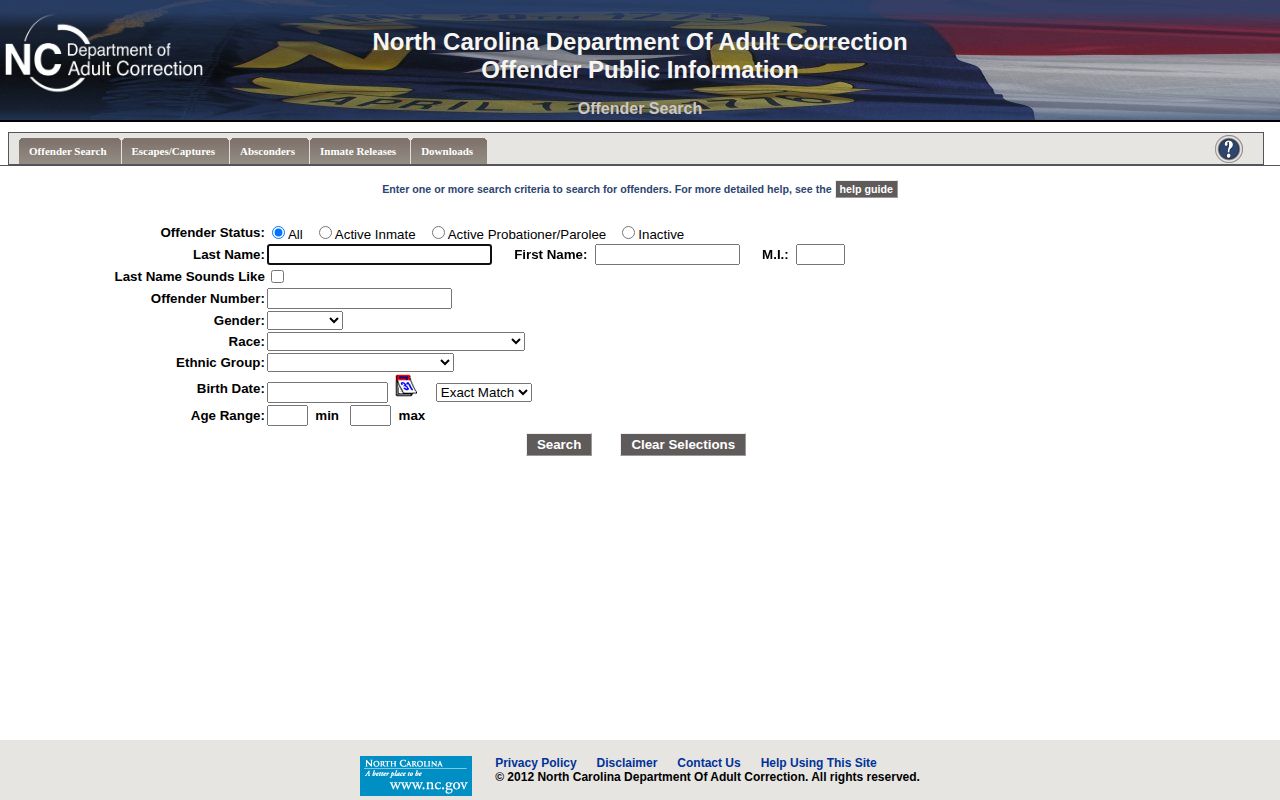
The search screen leads to the sentence and status blocks where NCDAC presents projected and actual release fields.
Note: An NCDAC no-match does not prove release from the Montgomery County jail because county-only detainees may never enter OPI.
Montgomery Earned-Time Release Rules
North Carolina Structured Sentencing uses minimum and maximum terms. Under G.S. 15A-1340.13(d), a felony prisoner must serve the minimum term. Earned time can reduce the maximum-term calculation within statutory limits, but it cannot reduce the term below that minimum. G.S. 148-13 authorizes NCDAC earned-time rules and directs local jail administrators to follow applicable rules for sentenced jail prisoners.
For an activated misdemeanor, G.S. 15A-1340.20(d) and related law cap combined earned-time awards at no more than four days per month. DWI and other special categories may operate differently. This is why a county jail sentence should be computed by the jail from the actual commitment record, not by copying a state-prison formula.
Earned time is not the same as credit for time already spent in custody. The court judgment may address jail credit, while the custodian applies the governing sentence rules and approved credits. Consecutive sentences run one after another; concurrent sentences run at the same time. Errors or changes in those relationships can move the public date.
- Minimum term
- The custodial floor a Structured Sentencing felony prisoner must serve.
- Maximum term
- The longer statutory term used with earned time and post-release supervision rules.
- Detainer
- A request or legal notice that another authority may take custody when the current term ends.
- Earned time
- Sentence credit awarded under correctional rules; it is not a promise of release on a fixed day.
Montgomery PRS Date Structure
Post-release supervision is built into many North Carolina felony maximum terms. Under G.S. 15A-1368.2, the PRS release date generally equals the maximum term minus 12 months for Class B1 through E felonies, or minus nine months for Class F through I felonies, less earned time. For specified registration offenses with an enhanced maximum, the corresponding subtraction is 60 months.
The supervision period generally matches those 12-month or nine-month periods, or five years in the specified registration category. Successful completion terminates the sentence. Earned time during supervision may reduce PRS by no more than 20 percent. Those rules explain why a person can have an Actual Release Date from incarceration while the full sentence has not yet ended.
Parole is different. It mainly applies to parole-eligible older-law sentences and narrow statutory cases. A Commission action can affect an eligible person’s release, but parole should not be inserted into every current Structured Sentencing calculation. Read the record’s actual legal category.
Montgomery 85 Percent Rule
North Carolina’s careful truth-in-sentencing shorthand is 100 percent of the minimum and 85 percent of the maximum. It is not a universal rule that everyone leaves after serving 85 percent of the sentence. The minimum must be served. Sentence class, offense-specific law, earned time, the maximum-term structure, and PRS all matter.
The Commission’s parole-process explanation supplies that shorthand. It should be used to understand the system, not to create a personal calculator. Multiplying a sentence by .85 can produce a false date because it ignores the imposed minimum and the statutory PRS subtraction.
OPI’s Projected Release Date is the public calculation to read for an active state sentence. Keep the label exact. Do not rename it Actual Release Date or promise that it will remain fixed. For a county sentence, ask the Montgomery jail for the computation applied to the commitment.
Why Montgomery Release Dates Change
A projected date reflects the facts known to the correctional system at that time. Changes to sentence credits, court records, custody demands, or legal status can alter the result. Some events move the date itself. Others prevent community release even when the current custodian’s term ends.
| Factor | Effect on the release date |
|---|---|
| Earned time | Awards or forfeitures can change the maximum-term calculation within statutory limits. |
| Court correction or jail credit | An amended judgment or corrected credit can change the sentence computation. |
| Concurrent or consecutive terms | A correction to how terms relate can move the projected endpoint. |
| New sentence or detainer | Another authority may continue custody after the current term. |
| Parole or supervision action | Applicable Commission action or revocation can alter custody and later release history. |
| Data correction | NCDAC may update a public field after reviewing the underlying record. |
A detainer is especially easy to misread. It can mean one agency releases its hold while another takes custody. The first date remains an end to that incarceration period, but it is not proof the person entered the community.
Note: A transfer date ends one location’s custody but is not an Actual Release Date to the community.
Confirm Montgomery Actual Release
For a state prisoner, recheck OPI close to the projected date and again after the event. Look for Actual Release Date, service status, and both header statuses. If supervision follows, the Community Supervision record should be read as the next stage rather than proof that prison release failed.
NC SAVAN/VINELink can send qualifying custody-change alerts for a named person. Registration and PIN steps are covered in the Montgomery VINE inmate check. An alert is useful notice, but the releasing agency remains the source for exact time, release type, and any transfer destination.
For Montgomery County Detention Center, call 910-576-4261 and request the booking/release record when documentary proof is needed. Pair it with the court judgment or release order. For NCDAC, use the offender number in a state records request. This final reconciliation distinguishes a forecast, physical exit, transfer, and continuing supervision.
NCDAC also maintains a separate Inmate Release Search that can filter Release County as Montgomery, county option 62, plus a selected year and month. Observed results include offender number, name, release date, primary offense, and release type. This can corroborate a completed state-prison event after the fact, but it is not the source for a future projected date. Its window is monthly, its visible year range can roll, and it does not cover everyone who leaves Montgomery County Detention Center. Use the OPI person record for the projected calculation and the monthly release search only as a state-release cross-check.